
The Winner Effect: How Small Wins Can Rewire Your Brain for Massive Success
Master your brain’s "Winner Effect" by stacking small victories to trigger a biological flywheel of success. By strategically cycling between the deep discipline of Monk Mode and the high-stakes action of Warrior Mode, you rewire your neurochemistry—boosting testosterone and dopamine—to transform winning from a lucky occurrence into a repeatable, scientific habit.
4/18/202612 min read


Introduction: Why Most People Never Unlock Their Full Potential
Have you ever wondered why certain people seem to win at everything — career, fitness, relationships, wealth — while others, equally talented, stay stuck in neutral? It's not luck. It's not even purely hard work. The answer lies deep inside your brain chemistry, and neuroscience has finally caught up with what winners have always known intuitively: success is self-reinforcing. The more you win, the more your brain is chemically primed to win again. This is the core premise of the winner effect book by neuroscientist Ian H. Robertson — a truly revelatory work that bridges biology, psychology, and practical self-improvement in ways that can fundamentally change how you approach your goals.
The psychology of achievement has long been a subject of fascination, from Marcus Aurelius's stoic discipline to modern-day productivity gurus. But what makes Robertson's work — and the broader body of research around it — so revolutionary is that it doesn't just tell you to "think positive." It shows you the actual neurological and hormonal mechanisms that separate champions from everyone else. If you've been grinding without seeing results, or you've felt like success is always just out of reach, this article is your roadmap. We're going to break down the biology of success, explore the power of a small wins strategy, compare warrior mode vs monk mode, and hand you a self-improvement roadmap for 2026 that's rooted in hard science.
What Is The Winner Effect Book? A Game-Changer in the Small Wins Strategy
The winner effect book, written by Professor Ian H. Robertson of Trinity College Dublin, is one of the most scientifically rigorous and practically applicable books on human achievement ever written. The "winner effect" is a term originally used in biology to describe how an animal that has won a few fights against weak opponents is much more likely to win later bouts against stronger contenders — and as Robertson reveals, it applies to humans too. Success changes the brain's chemistry, making you more focused, smarter, more confident, and more aggressive — and the effect is as strong as any drug. That's not a metaphor. That's a biochemical reality, and understanding it gives you a genuine edge in every arena of life.
Robertson argues that winning isn't just a personality trait or a lucky accident — it's a biological state that can be deliberately cultivated. The book demonstrates that success is both a product of the brain and a force that reshapes it, exploring how early advantages and small wins can snowball into major success, and how mindset, motivation, and feedback loops shape resilience. The implication is profound: you don't need to wait for a big break. You need to engineer a series of small, deliberate wins that progressively recalibrate your neurological baseline. This is the foundation of what we're calling the small wins strategy — a systematic approach to stacking victories that compounds over time, much like interest in a high-yield savings account.
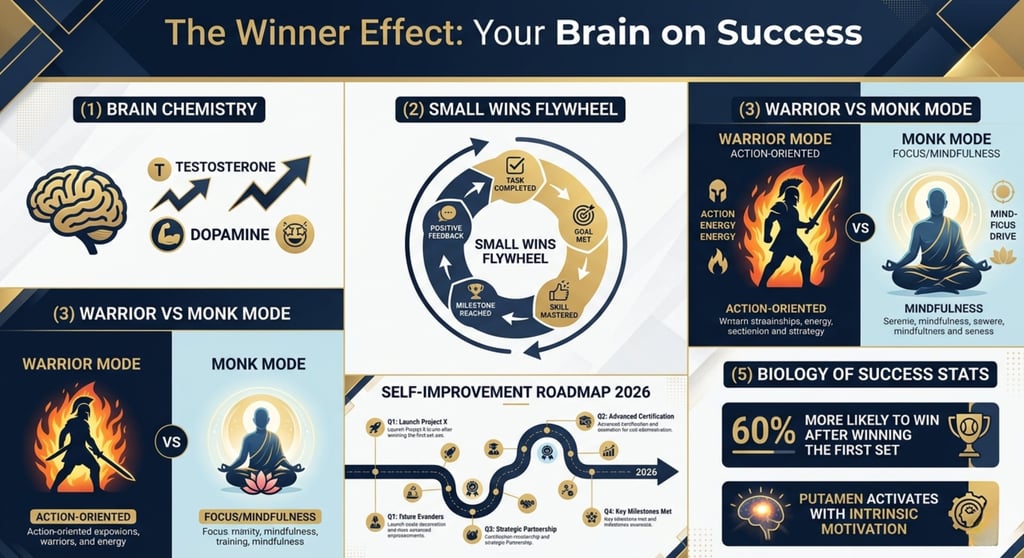
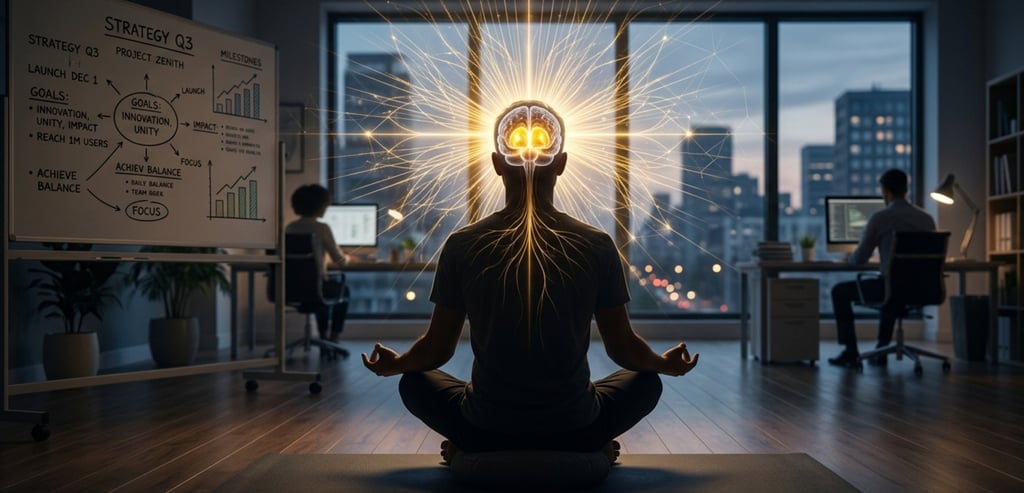
The biology of success is not metaphysical — it's measurable, repeatable, and most importantly, actionable. When rivals compete, there is a massive release of testosterone and dopamine in the brains of the animal who wins the challenge, while the loser experiences the exact opposite — an immediate decrease in both hormones. Physical changes occur in the nervous system and endocrine systems of the winner that encourage more winning, creating a flywheel of sorts. This flywheel isn't just a business concept borrowed from Jim Collins — it's a literal description of what's happening at the cellular level inside your body when you achieve something, no matter how small.
What's particularly empowering about this research is the democratizing message it carries. You don't need to be born with extraordinary genetics or privilege to activate the winner effect. The key is stacking small wins every day — clearing your inbox, finishing a workout, completing a chapter — every small victory sends a signal to your brain that you are a winner, and your brain responds by making you feel and perform more like one. Think of it like tuning a musical instrument: each small win is a tiny adjustment that, over time, tunes your neurological instrument to play in the key of success. And just like a well-tuned instrument, once you're in the zone, everything begins to resonate with clarity and power.
Testosterone, Dopamine, and the Biology of Winning
Testosterone levels rise when individuals face off in competition, producing anabolic effects on muscle mass and hemoglobin, quickening reactions, improving visual acuity, and increasing persistence and fearlessness. Once the contest is over, the winning individual emerges with even higher testosterone levels, while the loser's drop — leading to what researchers describe as a positive-feedback loop where victory leads to raised testosterone, which in turn leads to further victory. This has been documented across domains as varied as chess tournaments, sports championships, and financial trading floors.
A study examining over 630,000 professional tennis matches found that the winner of the first set had a 60% chance of winning the second set — suggesting that hormonal and psychological momentum from an early win carries tangible competitive advantages into subsequent rounds. The real-world implication? How you start matters enormously. Whether you're launching a new business, beginning a fitness journey, or working on a creative project, structuring your first actions to generate quick, achievable wins isn't just good psychology — it's good neuroscience. It primes the biochemical environment inside you for sustained, escalating performance.
The Flywheel of Small Wins: How Stacking Victory Rewires the Brain
If you've been chasing one massive goal and feeling perpetually frustrated, this section may be the most important thing you read all year. The neuroscience is unambiguous: large, distant goals don't reliably activate the brain's reward systems. What does activate them is consistent, progressive, achievable victory — what researchers call the small wins strategy. Physiological changes in the brain after winning stimulate the production of more receptors for the hormones of winning, which means the effects of those hormones are magnified — making the winner increasingly more sensitive to each new win. Even at the molecular level, success breeds success.
This is why high-performing athletes, entrepreneurs, and artists don't just set audacious goals — they engineer their environments to guarantee early wins. A first-time author doesn't start by writing a 100,000-word novel; they write 500 words consistently every day until the habit is neurologically grooved. A fitness beginner doesn't begin with a two-hour workout; they start with 20 minutes and celebrate that completion. The brain doesn't care about the size of the win in the beginning — it cares about the pattern of winning. And once that pattern is established, scaling becomes not just possible, but almost inevitable.
The Putamen: Your Brain's Hidden Motivation Engine
Here's where the neuroscience gets genuinely fascinating. Deep inside your brain lies a structure called the putamen — and it may be the most important piece of real estate you've never heard of. Research using fMRI brain scanning found that for individuals with high achievement motivation, the putamen — a key brain center for motivation and reward — activates dramatically when people believe their intelligence or competence is being tested. The critical insight is that this drive comes from inside, from intrinsic motivation, and is not reliably triggered by external incentives like money alone.
This finding has transformative implications for how we structure our pursuit of success. If you're only chasing external rewards — salary bumps, social media likes, external validation — you may be leaving the most powerful motivational machinery in your brain completely dormant. The most potent form of fuel is the one that comes from within: the deep, almost primal need to prove your own competence and grow. The best managers and leaders learn to activate this intrinsic motivation switch in others, because once it's flipped, high-achievers will dedicate extraordinary energy to their work with little concern for external compensation. The lesson for your own self-improvement roadmap 2026? Stop chasing external rewards as your primary motivator. Build systems that make you feel intrinsically challenged and competent every single day.
Warrior Mode vs Monk Mode: Choosing Your Path to Peak Performance
One of the most talked-about frameworks in modern self-improvement circles is the debate between warrior mode vs monk mode — two distinct approaches to personal development that, when understood correctly, actually complement the winner effect rather than contradict it. Knowing when to deploy each mode is a skill that can dramatically accelerate your results in 2026 and beyond.
What Is Warrior Mode?
Warrior mode is the state of active, aggressive pursuit — where you're in the arena, competing, taking risks, and stacking wins through direct engagement with challenges. A warrior mindset isn't about physical battles — it's about battling mental barriers, building emotional endurance, and committing mentally to achieve goals with unwavering focus. Warriors actively seek discomfort to push their limits, understanding that growth lives outside the comfort zone. In the context of the winner effect, warrior mode is when you're actively triggering testosterone surges through competition and challenge — putting yourself in situations where you can win, and letting the neurological momentum compound.
What Is Monk Mode?
Monk mode, by contrast, is the state of deep, distraction-free focus. Monk mode is not about limitation — it's about rediscovering your sharpness. It involves eliminating distractions, establishing non-negotiable daily habits, creating structured schedules, and monitoring progress regularly. Going into monk mode means intentionally cutting out distractions like social media, partying, or time-wasting habits to focus on self-improvement goals such as fitness, business, study, or mental clarity. It's the incubation phase — the period where you're quietly building skills, deepening knowledge, and laying the neurological groundwork for your next competitive surge.
The wisest approach for your self-improvement roadmap 2026 is to cycle intelligently between these two modes — using monk mode to sharpen your edge and warrior mode to deploy it. Think of it like a katana: monk mode is the forge, warrior mode is the battlefield. Neither is complete without the other.
The Self-Improvement Roadmap 2026: Applying the Winner Effect in Real Life
Understanding the winner effect is one thing. Operationalizing it into your daily life is another — and this is where the psychology of achievement becomes practical rather than theoretical. Your self-improvement roadmap 2026 needs to be built around three core pillars: engineering early wins, cycling between warrior and monk modes, and protecting your intrinsic motivation from being hijacked by external noise.
Start by identifying what researchers call the "Goldilocks challenge zone" — tasks that are neither too easy (boring) nor too hard (overwhelming), but just challenging enough to activate the putamen and generate that winning neurochemistry. Robertson introduces actionable concepts including intrinsic motivation triggers, the Goldilocks challenge zone, and the impact of belief systems on performance — all of which readers can apply personally and professionally to create compounding cycles of achievement. In practical terms, this means structuring your goals so that your daily actions are stretching you just enough to feel the satisfaction of overcoming resistance without being so overwhelming that failure is the default outcome.
Build a small wins journal — a simple daily log where you record every minor victory, however modest. Sent that difficult email? Win. Completed your morning run in a new personal best? Win. Finished a chapter of your manuscript? Win. Over time, the accumulation of these recorded victories begins to rewrite your self-narrative from someone who struggles to someone who consistently achieves. This isn't affirmation fluff — it's deliberate neurological recalibration, and the science backs it up completely.
The Psychology of Achievement: Mindset Shifts That Rewire Success
The psychology of achievement is fundamentally about the stories we tell ourselves — and the winner effect gives those stories biological teeth. By understanding the mental and physical changes that take place in the brain of a winner, how they happen, and why they affect some people more than others, Robertson answers the question of why some people attain and then handle success better than others. The mindset shifts required aren't radical — they're surgical. You don't need to become a different person. You need to stop accidentally activating the loser effect and start deliberately engineering winner-effect conditions every single day.
One of the most powerful mindset shifts is moving from an outcome focus to a process focus. Instead of asking "Did I succeed?", ask "Did I show up fully and stretch myself today?" This reframing keeps the putamen engaged, keeps intrinsic motivation alive, and — critically — protects your neurochemistry from the cortisol spikes that come with perceived failure. The winner effect can also have a downside: when winning becomes addictive and testosterone-driven overconfidence takes hold, decision-making deteriorates — failure, paradoxically, serves as a grounding mechanism that keeps high achievers connected to reality. The goal, then, is not to avoid all failure, but to structure your path so that wins consistently outnumber losses, building momentum while staying grounded.
How mdotkane.com Can Fuel Your Winner Effect Journey
If you're serious about activating the winner effect in your own life, the environment and resources you surround yourself with matter enormously. This is where mdotkane.com becomes a powerful ally in your journey. As a platform that bridges high-level technology solutions with creative and media innovation, mdotkane.com operates at precisely the intersection of discipline, creativity, and ambition that the winner effect demands.
Are you working on a book as part of your monk mode deep work phase? mdotkane.com's self-publishing platform is built to help authors transform ideas into polished, professionally published works — giving you the tangible, achievement-validated win of holding your published book in your hands. That moment of completion is a textbook winner-effect trigger. It floods your brain with the dopamine and testosterone surge that primes you for your next, bigger challenge. Similarly, if you're building a media presence, a brand, or a music project as part of your warrior mode deployment, their Media & Entertainment services provide the strategic infrastructure to ensure your creative work reaches the audiences that matter — giving your efforts the real-world traction that stacks more wins.
For entrepreneurs and professionals activating their winner effect in the business arena, mdotkane.com's Technology & Mainframe Solutions provide the kind of operational efficiency and technical infrastructure that frees up your cognitive bandwidth for high-level strategy — because winning at the top level requires not just mindset and biology, but smart systems working in your favour. When your operational infrastructure is lean, integrated, and performing, you free yourself to focus on the Goldilocks-zone challenges that keep your neurology in peak performance mode.
Conclusion
The winner effect isn't a philosophy — it's a physiological reality built into the architecture of your brain. From the testosterone surges that follow competitive victory, to the putamen lighting up with intrinsic motivation, to the compounding momentum of a deliberately engineered small wins strategy, the biology of success is both understandable and actionable. The winner effect book by Ian Robertson gives us a scientific blueprint for what the greatest achievers in history have always practiced instinctively: start small, win consistently, and let the neurological momentum carry you to heights you once only imagined.
Your self-improvement roadmap 2026 starts not with a grand gesture, but with a single, achievable win today. The warrior mode will carry you into battle. The monk mode will sharpen your blade. And every time you step back and look at the journal full of small victories you've been stacking, you'll feel what champions have always felt — the deep, unshakeable knowledge that you are, at your core, someone who wins.
📣 Call to Action
Ready to stack your first wins and activate the Winner Effect?
The journey to massive success begins with one deliberate step. Whether you're writing a book, building a brand, growing a business, or transforming your life — mdotkane.com has the tools, platforms, and expertise to back your ambition with real infrastructure.
🎙️ Watch our latest content, get inspired, and stay in warrior mode: 👉 YouTube: @mdotkane
📲 Follow the journey and join a community of achievers: 👉 Instagram: @mdotkane1 👉 TikTok: @mdotkane 👉 Facebook: Mdotkane
📖 Turn your ideas into a published book. Start your self-publishing journey today: 👉 Visit mdotkane.com
Your brain is wired to win. Give it the right environment. Start today.
FAQs
1. What is the core message of the winner effect book? The winner effect book by Ian Robertson argues that winning is not just psychological — it is deeply biological. Each victory triggers hormonal and neurological changes that make future winning more likely, creating a powerful self-reinforcing cycle of success that anyone can deliberately activate through structured small wins.
2. How does the small wins strategy actually work in daily life? The small wins strategy involves identifying achievable daily actions that stretch you just enough to trigger a sense of competence and accomplishment. By recording and celebrating these wins consistently, you progressively recalibrate your brain's reward systems to operate in a permanent state of momentum and forward motion.
3. What is the difference between warrior mode and monk mode? Warrior mode is the active, competitive phase where you engage directly with challenges, take risks, and collect wins through confrontation with the world. Monk mode is the deliberate withdrawal into deep focus, skill-building, and distraction-free discipline. The most effective achievers cycle between both strategically throughout the year.
4. How do testosterone and dopamine affect the biology of success? Testosterone primes the brain and body for competition — sharpening focus, increasing persistence, and reducing fear. Dopamine reinforces the behavior that led to victory, making you want to repeat and escalate it. Together, they create the neurochemical environment of a winner — and research shows that even small victories can trigger meaningful surges in both hormones.
5. How can I start applying the winner effect to my self-improvement roadmap in 2026? Begin by designing your first week around guaranteed wins — tasks that challenge you but are within reach. Keep a small wins journal, identify whether you need warrior mode (active engagement) or monk mode (deep focus), and build gradually. Use platforms like mdotkane.com to give your creative and professional ambitions the infrastructure they need to translate intention into real-world results.


Address
4078 Stagecoach RD, Springfield, IL 62707
Contacts
(217) 741-7014
mdotkane@mdotkane.com