
Feels Stuck — Read The Effective Executive
Stop confusing busyness with productivity. Discover why a 60-year-old business classic is the ultimate survival guide for the modern knowledge worker. Learn how to master your time, play to your strengths, and finally get the right things done.
4/16/202617 min read


Have you ever sat at your desk on a Tuesday afternoon, watching the clock crawl toward 5 PM, wondering if this — the emails, the meetings, the "urgent" tasks that never quite feel important — is really all there is? You're not lazy. You're not incompetent. You might just be doing the wrong things, in the wrong order, for all the wrong reasons. And a book written back in 1967 by a man named Peter Drucker saw you coming from a mile away.
The Effective Executive is not a self-help book in the motivational-poster sense. It doesn't ask you to wake up at 5 AM or cold plunge your way into greatness. What it does instead is far more useful — it teaches you how to think like someone who actually gets results. Whether you're a mid-level manager, a freelancer, a creative, or a factory floor supervisor who dreams of something bigger, this book speaks directly to your situation. It's a quiet revolution between two covers, and it might just be the most important thing you read this year.
What Is The Effective Executive by Peter Drucker — And Why Should a 9-to-5 Worker Care?
A 60-Year-Old Book That Still Hits Different
The Effective Executive by Peter Drucker was originally published in 1966, which means it has been quietly changing how smart people work for nearly six decades. That's not a small feat in a world that moves at the speed of a trending LinkedIn post. Most business books have a shelf life of about three years before they feel dated. Drucker's masterwork, however, reads as though it was written last month — because the human condition at work hasn't fundamentally changed. We still waste time. We still confuse busyness with productivity. We still let urgent tasks crowd out the truly important ones. Drucker diagnosed this disease before most of us were even born, and his cure is just as potent today as it ever was.
The reason this book resonates so deeply with the everyday 9-to-5 worker is that Drucker doesn't assume you're the CEO of a Fortune 500 company. He assumes you're a knowledge worker — someone whose primary output is information, decisions, and ideas rather than physical goods. Drucker reminds us that the measure of the executive is the ability to "get the right things done," and that intelligence, imagination, and knowledge may all be wasted without the acquired habits of mind that improve productivity and mold them into results. That phrase — "the right things" — is the whole game. Most of us are extremely good at getting things done. The question Drucker forces us to ask is whether those things actually matter.
Who Exactly Is an "Executive" According to Drucker?
Here's where Drucker flips the script in a way that immediately makes this book relevant to everyone, not just corner-office types. Whether you work in a business or in a hospital, in a government agency or in a labor union, in a university or in the army, the executive is, first of all, expected to get the right things done. By this definition, you are an executive. If your work requires you to make decisions — even small ones — that affect outcomes for yourself or others, you are operating as an executive in Drucker's framework. The receptionist who decides how to handle an angry client, the software developer who chooses which bug to fix first, the writer who decides which story angle serves the reader best — all of these people are exercising executive judgment every single day.
This reframing is enormously liberating. It means that the lessons of The Effective Executive by Peter Drucker aren't reserved for a privileged management class. They're tools that any person, at any level, can pick up and use starting tomorrow morning. And when you pair these tools with the right platform to grow your creative and professional reach — like mdotkane.com, which bridges the gap between creative ambition and technical infrastructure — you start to see what real effectiveness looks like in practice.
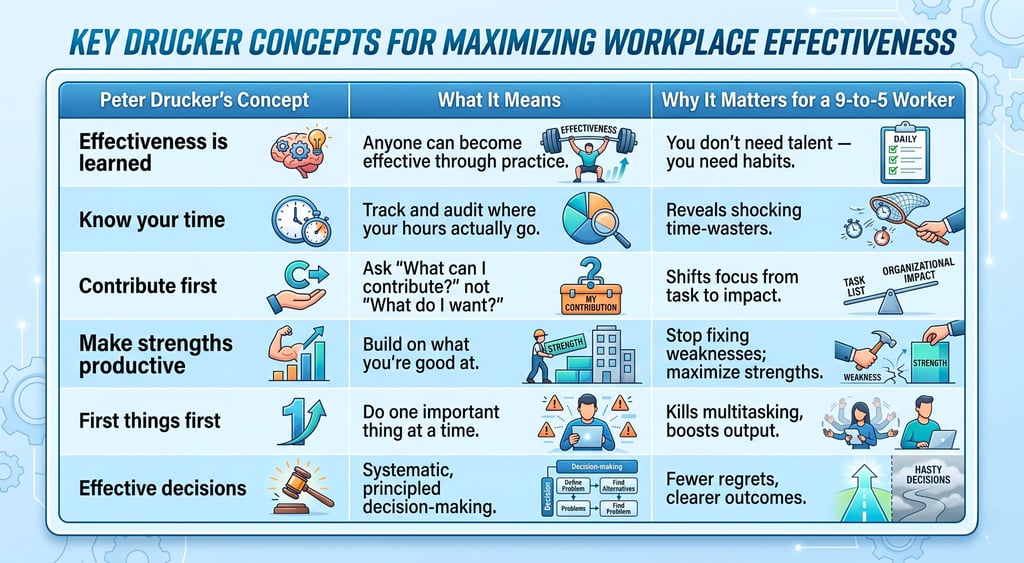
Table 1: The Effective Executive — Key Concepts at a Glance
The Core Philosophy of The Effective Executive — Effectiveness Is Learned, Not Born
The good news is, effectiveness can be learned. Specifically, it is the result of learning and practicing a small number of simple practices until they become habit. This single sentence should feel like someone just turned on the lights in a dark room. Because here's the thing — most of us grew up believing that high performers were born that way. We thought effectiveness was a personality trait, something encoded in your DNA, not a skill set you could deliberately build over time. Drucker demolishes this assumption with elegance and precision. He argues, with the weight of decades of organizational research behind him, that every effective executive he ever studied had learned to be effective — none of them were simply born that way.
This matters enormously for the person who feels stuck in their 9-to-5. If effectiveness is genetic or personality-based, then feeling stuck is just your fate. But if effectiveness is a learnable discipline — a set of habits you can pick up, practice, and refine — then feeling stuck is merely your current situation, not your permanent state. You can change it. Drucker gives you permission to believe that, and then he gives you the map.
The 5 Habits Drucker Says Every Effective Person Must Master
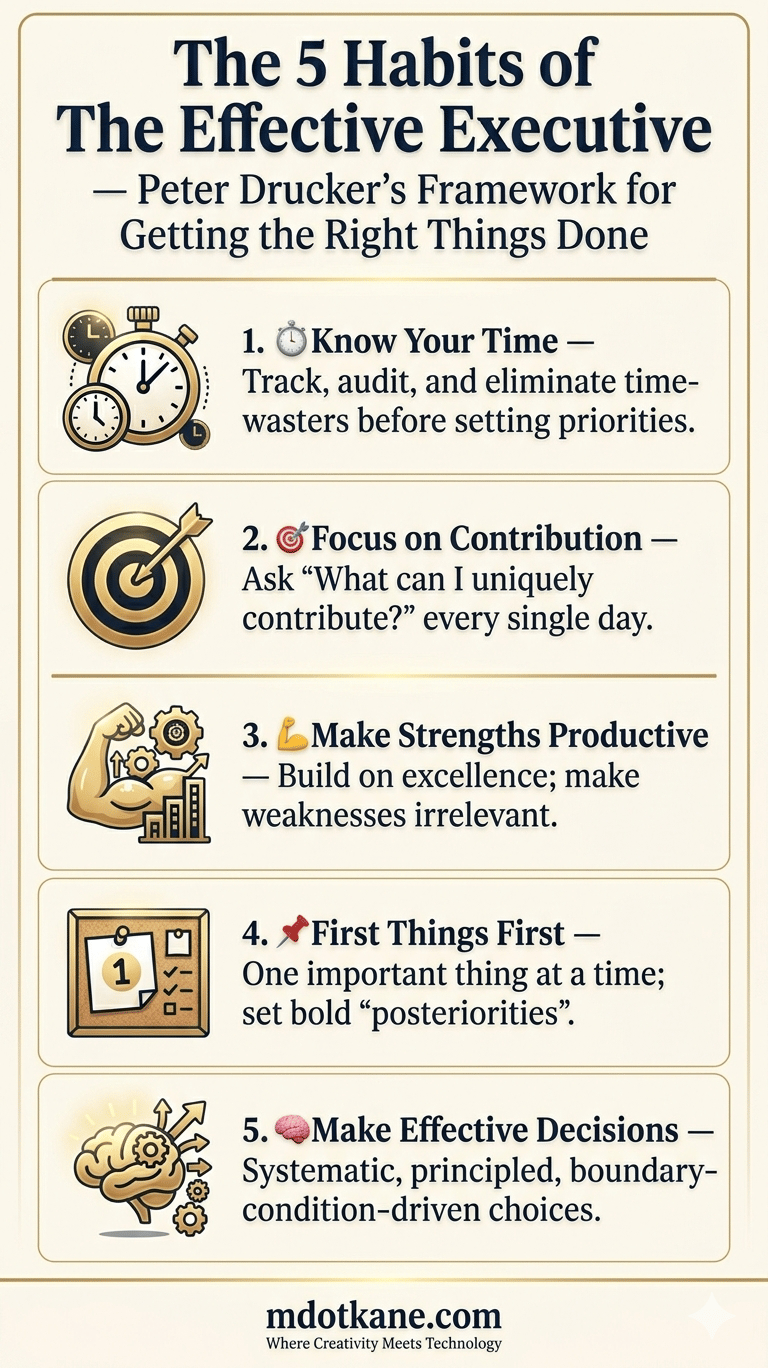
Drucker argues that the effective executive is defined by practices rather than attributes. Therefore, he argues, effectiveness can be learned by practising the 5 habits of effective executives. These five habits are not complicated. They're not counterintuitive in the way that makes you feel clever for understanding them. They're almost embarrassingly straightforward — which is exactly why so few people actually practice them. The habits are: managing time deliberately, focusing on contribution rather than effort, making strengths productive, doing first things first, and making effective decisions. Each habit builds on the last, and together they form a complete operating system for getting the right things done in the real world.
Habit 1 — Know Where Your Time Goes
Effective executives know that time is the limiting factor. To be effective, every knowledge worker needs to be able to dispose of time in fairly large chunks. To have small dribs and drabs of time at his disposal will not be sufficient even if the total is an impressive number of hours. Think about your average workday. How much of it is spent in meetings that could have been emails? How much time evaporates into chat notifications, social media scrolls, and the low-grade anxiety of an overflowing inbox? Drucker prescribes something radical: before you do anything else, record where your time actually goes. Not where you think it goes — where it actually goes. Most people are shocked by the results. The gap between perceived and actual time use is almost always enormous, and closing that gap is where the journey to effectiveness begins.
Peter Drucker Time Management — The Most Radical Productivity Advice You've Never Tried
Peter Drucker productivity thinking is built on a foundation that most time-management gurus quietly borrowed without giving him credit. The idea that time is your scarcest resource — not money, not talent, not connections — was Drucker's central insight, and it runs through everything in The Effective Executive like a steel cable. The three steps Drucker recommends are: Record — find out where your time actually goes; Manage — cut back unproductive demands on your time; and Consolidate — "discretionary" time into the largest possible continuing units. This three-step system sounds simple, but executing it requires a kind of ruthless self-honesty that most people actively avoid.
The recording phase alone is revelatory. Once you have enough data, say 2 weeks, you will notice patterns and time-wasters like email and social media that eat into your productivity. Drucker argues that removing distractions is the right thing to do now, instead of setting priorities for what you should be doing. This is such an important distinction that it bears repeating. Most productivity systems jump straight to prioritization — telling you to figure out what matters most and do that first. Drucker says wait. Before you can prioritize, you have to eliminate. You have to surgically remove the time-wasting activities that are consuming your hours before you can give real, concentrated attention to what actually matters. It's the equivalent of cleaning your desk before you start writing — except the desk is your entire life.
Stop Multitasking and Start Consolidating
One of the most practically useful ideas in The Effective Executive by Peter Drucker is the concept of time consolidation. Consolidation means you should group your remaining "discretionary" time to work on things that move the needle — in the largest possible chunks of time. This is usually between half a day and 2 weeks. According to Drucker, you need to minimise context switching and focus on one important task until it's done. If you've ever tried to do deep, creative, or strategic work in 15-minute windows between meetings, you already know how futile this feels. Your brain needs time to warm up, to sink into a problem, to generate the kind of insight that actually moves the needle. Fragmented time produces fragmented thinking, and fragmented thinking produces mediocre results — no matter how intelligent you are.
This is why so many people in the modern workplace feel perpetually busy but chronically unproductive. They're working in the cracks. They're trying to build a cathedral using whatever five spare minutes they can find between Zoom calls. Drucker saw this trap coming and prescribed the antidote with precision: block large, uninterrupted chunks of time for your most important work, protect those blocks ferociously, and use them for nothing else. The quality of your output will change almost immediately.
Cutting Unproductive Demands — The Art of Saying No to Busy-ness
Effective executives start out by estimating how much discretionary time they can realistically call their own. Then they set aside continuous time in the appropriate amount. And if they find later that other matters encroach on this reserve, they scrutinize their record again and get rid of some more time demands from less than fully productive activities. This is the part of Peter Drucker time management philosophy that most people find the hardest to implement, because it requires saying no to people, to requests, to opportunities that feel important in the moment but aren't actually serving your most valuable contribution. It requires the uncomfortable act of disappointing some people in the short term in order to deliver real value in the long term. That's not a skill that comes naturally to most of us — but it is absolutely learnable.
Making Strengths Productive — Why Fixing Weaknesses Is the Wrong Strategy
Here's one of Drucker's most counterintuitive and liberating ideas, one that runs completely against the grain of how most organizations and school systems operate: Don't focus on problems and limitations; focus on opportunities, strengths and what you can do. The goal of organization is to use the strength of every person as a "building block for joint performance." Most performance reviews, most annual appraisals, and most self-improvement programs are obsessed with weaknesses. They identify your gaps, your areas for development, the things you're not good at — and then they dedicate enormous energy to pulling you up to average in those areas. Drucker says this is a catastrophic waste of human potential.
Think about it like this: if you're a brilliant writer but a terrible accountant, spending years becoming a mediocre accountant makes you neither a great writer nor a great accountant. You've sacrificed your superpower on the altar of balance. Drucker's prescription is the opposite — go deep into your strengths, build on what you're already extraordinary at, and find ways to manage or delegate your weaknesses rather than spending precious energy trying to fix them. According to Drucker, strengths can make weaknesses irrelevant. That's a powerful reframe. Your weakness doesn't have to be solved — it just has to stop being in the way of your strength.
Play to Your Strengths at Work
Effective executives build on strengths—their own, their superiors, colleagues, and subordinates; and on the strengths in the situation, that is, on what they can do. The practical implication of this for a 9-to-5 worker is significant. It means you should be actively looking for ways to reshape your role around what you're genuinely excellent at, advocating for projects that play to your natural abilities, and building teams or partnerships that compensate for your blind spots. It means having honest conversations with your manager about where you add the most value, rather than passively accepting whatever tasks land in your inbox. It means treating your career not as something that happens to you, but as something you actively engineer around your authentic capabilities.
How mdotkane.com Helps You Discover and Develop Your Strengths
For those who feel their creative or entrepreneurial strengths are being smothered by a conventional career structure, mdotkane.com offers a genuinely different kind of platform. Whether your strength lies in writing — and you're ready to turn that manuscript into a published book through their self-publishing platform — or in storytelling through music and media, mdotkane.com provides the infrastructure to take those strengths to the next level. Drucker would approve: the platform is designed not to make you a little better at everything, but to take what you're already passionate and capable of and give it a professional launchpad. For the 9-to-5 worker who secretly knows their real contribution lies outside their day job, this kind of resource is invaluable.
The Effective Executive Book Review — What Makes It Different From Every Other Productivity Book
Let's be honest — the productivity genre is drowning in noise. For every genuinely useful idea, there are seventeen variations of "wake up earlier," "do a brain dump," and "eat the frog." What sets The Effective Executive apart in this crowded landscape is that it doesn't offer you a morning routine or a productivity app recommendation. It offers you a philosophy. Drucker argues that "the realities of the executive's situation both demand effectiveness from him and make effectiveness exceedingly difficult to achieve. Indeed, unless executives work at becoming effective, the realities of their situation will push them into futility." That sentence alone contains more insight than most full-length productivity books published in the last decade.
The book is also refreshingly honest about the difficulty of effectiveness. It doesn't promise you that these habits are easy to implement. It doesn't tell you that a 21-day challenge will transform your life. What it tells you instead is that effectiveness requires ongoing, deliberate practice — that it is a discipline, like physical fitness, that must be maintained and refined over time. Effectiveness needs to be learned. Effectiveness is after all not a subject but self-discipline. With courage, knowledge becomes productive. That last line is particularly potent. Courage. Because implementing Drucker's principles requires the courage to say no, the courage to focus when the world is screaming at you to scatter, and the courage to be different from the busy, distracted, reactive crowd around you.
Drucker vs. the Modern Productivity Gurus
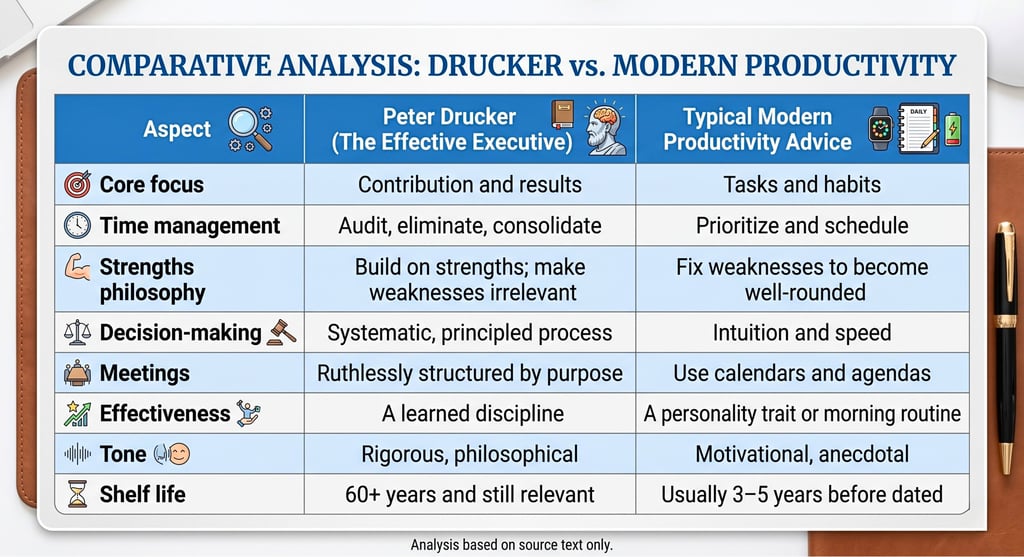
The Effective Executive book review conversation inevitably includes a comparison with the wave of productivity literature that has followed in Drucker's wake. Cal Newport borrowed the concept of deep work directly from Drucker's time consolidation ideas. Stephen Covey's "first things first" is lifted almost verbatim from Drucker's chapter headings. Even the "four-hour workweek" concept owes a philosophical debt to Drucker's insistence on identifying the few high-leverage activities that produce the most meaningful results and eliminating everything else. The difference is that Drucker's original formulation is cleaner, more rigorous, and far less cluttered with personal anecdote and motivational framing than many of its successors.
A Comparison Table — Drucker vs. Conventional Productivity Advice
First Things First — The Prioritization Framework That Changes Everything
The Courage to Set "Posteriorities"
There are always more productive tasks for tomorrow than there is time to do them and more opportunities than there are capable people to take care of them. A decision has to be made as to which tasks deserve priority and which are of less importance. The only question is which will make the decision — the executive or the pressures. This is the core tension of the modern workplace, and Drucker names it with surgical precision. Either you choose what matters, or your inbox, your calendar, and other people's urgencies will choose for you. And here's the uncomfortable truth: if you've been feeling stuck in your 9-to-5, it's very likely because you've been letting the pressures choose.
The reason why so few executives concentrate is the difficulty of setting "posteriorities" — that is, deciding what tasks not to tackle — and of sticking to the decision. Courage rather than analysis dictates the truly important rules for identifying priorities. Posteriorities. That word alone is worth the price of the book. Everyone knows how to make a to-do list. Almost no one knows how to make a "not-to-do" list and actually stick to it. Drucker argues that the second list is where real effectiveness lives — in the courageous decision to stop doing things that aren't serving your most important contribution, even if they're comfortable, familiar, or expected.
How Contribution Thinking Transforms Your Daily Work
One of the most profound questions in The Effective Executive by Peter Drucker is deceptively simple: "What can I contribute?" Not "What am I being asked to do?" Not "What does my job description say?" But genuinely — what contribution can I make that will make a real difference to the performance and results of this organization, this team, this project? The man who asks of himself, "What is the most important contribution I can make to the performance of this organization?" asks in effect, "What self-development do I need? What knowledge and skill do I have to acquire to make the contribution I should be making?" When you ask that question every morning before you open your email, your whole relationship with your work starts to shift.
This contribution mindset is also at the heart of what platforms like mdotkane.com are built to support. Their media strategy and engagement services, for instance, are designed precisely to help individuals and organizations ask — and answer — the question of what unique value they can bring to their audience. For a creative professional trying to bridge the gap between a day job and a meaningful body of work, having a partner that thinks in terms of contribution rather than just activity is a genuine game-changer.
Making Effective Decisions — The Framework Every Stuck Worker Needs
Effective executives know that effective decision-making is a matter of system — the right steps in the right sequence. This is the part of The Effective Executive that most people skip over, because decision-making sounds dry compared to the sexier topics of time management and productivity. But Drucker argues — convincingly — that the quality of your decisions is ultimately the quality of your results. Every outcome in your professional life is a downstream consequence of a decision made somewhere upstream. If you're getting poor outcomes, trace them back and you'll almost always find a poorly made decision at the root.
Drucker identifies several key principles for effective decision-making that still feel fresh and applicable today. The first is boundary conditions — before you make any decision, you should be crystal clear about what the decision needs to accomplish and what constraints it must operate within. The second is starting with what's right rather than what's acceptable — too many decisions are compromised before they're even made because the decision-maker is already thinking about politics, personalities, and palatability rather than the right answer. Focus on what is right, measured against some clear boundary conditions which define success and performance, and use this to guide compromises instead of focusing on what is acceptable.
Is a Decision Even Necessary?
One of the most refreshing aspects of Peter Drucker productivity thinking on decisions is his insistence on asking whether a decision is even needed in the first place. Is a decision really necessary? Think like a surgeon and don't intervene unneeded in systems, and operate and do the job fully. In a culture that celebrates decisiveness and action, Drucker's willingness to say "sometimes the best decision is no decision" feels almost rebellious. But it's profoundly wise. Not every problem requires intervention. Not every situation requires a response. Learning to distinguish between the situations that genuinely demand a decision and those that will resolve themselves if left alone is a massive time-saver — and a hallmark of the truly effective person.
Conclusion — The Stuck Worker Who Becomes Effective
You picked up this article because something in the title resonated — that feeling of being stuck, of working hard but not going anywhere meaningful. The Effective Executive by Peter Drucker doesn't promise to fix that overnight. What it does is give you a framework for understanding why you feel stuck and a concrete, tested, time-proven set of practices for becoming unstuck. It starts with time — auditing it, protecting it, and using it in large, uninterrupted blocks on your most important work. It moves through strengths — building on what you're genuinely excellent at instead of grinding away at your weaknesses. It arrives at contribution and decisions — the two places where your impact is ultimately determined.
Self-development toward effectiveness is the only available answer to the challenge of the modern knowledge worker. No one is coming to redesign your career for you. No algorithm is going to route the most important work to your desk automatically. The responsibility for becoming effective — for getting the right things done — belongs entirely to you. And that's actually great news, because it means the power to change your situation is already in your hands. Drucker just shows you how to use it.
For the 9-to-5 worker ready to go beyond the book and into action, mdotkane.com is a platform worth exploring — whether you're ready to publish your first book through their self-publishing platform, share your story through their media and entertainment network, or simply find a creative and technical home for the ideas you've been sitting on. Effectiveness isn't just a professional skill. It's a life philosophy. And it's time you started living it.
📣 Call to Action — Take the Next Step With mdotkane.com
You've just spent time with one of the most powerful ideas in business history. Now it's time to put that effectiveness into action. mdotkane.com is built for people exactly like you — creative, ambitious, and ready to bridge the gap between a good idea and a real result.
📖 Ready to publish your book? Their self-publishing platform helps authors turn ideas into polished, professional publications. Explore Publishing →
🎵 Have a music or media project? Discover how their media strategy services can amplify your reach and impact. See the Media Showcase →
💻 Need technical solutions? From mainframe integration to digital streamlining, their technology services keep your operations sharp. Learn About Tech Solutions →
Follow mdotkane.com on social media for daily insights, creative inspiration, and behind-the-scenes content:
🎬 YouTube — @mdotkane | 📘 Facebook | 📸 Instagram — @mdotkane1 | 🎵 TikTok — @mdotkane
Your effectiveness journey starts with one decision. Make it today.
Frequently Asked Questions
1. Is The Effective Executive suitable for someone who is not a manager or executive? Absolutely — and this is perhaps the biggest misconception about the book. Peter Drucker defines an "executive" as anyone who makes decisions that affect outcomes, which includes virtually every knowledge worker. Whether you're a junior analyst, a freelance designer, or a creative professional, the principles in The Effective Executive apply directly to your daily work life and career trajectory.
2. How long does it take to read The Effective Executive by Peter Drucker? The book is relatively concise at around 178 pages, making it achievable in a weekend of focused reading or a week of 20–30 minutes daily. Given the depth of ideas packed into those pages, many readers choose to read it slowly and take notes, treating it more as a workbook than a cover-to-cover read.
3. What is the single most important lesson from The Effective Executive? If forced to choose one, it would be the concept of managing your time before attempting to manage anything else. Drucker's insistence on auditing your time — recording, analyzing, and eliminating time-wasters — before setting any other priorities is the foundational practice on which all the other habits rest. Without this, the rest of the framework lacks traction.
4. How does The Effective Executive compare to more modern productivity books like Deep Work or Atomic Habits? The Effective Executive is the philosophical ancestor of both. Cal Newport's deep work concept directly mirrors Drucker's time consolidation principle, and James Clear's habit-stacking approach echoes Drucker's emphasis on practices over personality. The difference is that Drucker's framework is more comprehensive — it addresses not just how to work, but what to work on and why, making it a more complete operating system for professional effectiveness.
5. Can the lessons of Peter Drucker productivity thinking apply to creative careers, not just corporate ones? One hundred percent yes. In fact, creatives may benefit even more from Drucker's framework than traditional corporate workers. The principle of making strengths productive is especially powerful for artists, writers, musicians, and entrepreneurs who risk diluting their creative energy by trying to be everything to everyone. Platforms like mdotkane.com — which offers publishing, music, and media services alongside technical infrastructure — are built on exactly this principle: give creative people the support they need to go deep into their strengths rather than getting distracted by logistics.




Address
4078 Stagecoach RD, Springfield, IL 62707
Contacts
(217) 741-7014
mdotkane@mdotkane.com